
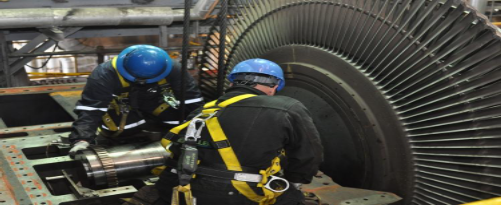

A steam turbine is susceptible to wear as well as aging processes, just like any other machine. Therefore, the goal of every maintenance is to ascertain and evaluate a machine’s state.
Through routine maintenance and repair procedures. This is to prevent wear or aging processes that result in failures.
Know that turbine inspection services may return the system to its original state. Additionally, the life expectancy of each design might be extended beyond the initial state. This is due to enhanced technology and design advancements.
How can gas turbine inspections be efficiently scheduled?
Many industrial processes and electricity generation rely heavily on gas turbines. They take care of everything from assuring dependability to increasing efficiency. In essence, they maintain everything until they stop. Gas turbine servicing is crucial because of this.
Knowing just when to examine your machines. And why scheduling is so important is the difficult part, though. First, keep in mind that there is no one-size-fits-all approach when it comes to turbines. When to plan maintenance depends on a number of factors. Including different models, running hours, and wear and tear levels.
Additionally, you will already be aware that maintenance intervals are determined by factored fired hours. Or factored fired starts, if you are adhering to GE’s GER 3620 advisory. Thus, these are the main queries:
Should you do an early inspection to lower the risk? Or should you postpone the checkup to reduce expenses?
We’ll go over all you need to learn regarding maintenance plans. Including why timing is crucial and how professionals can help you optimize performance while minimizing downtime.

The Principles
Gas turbines are designed to withstand harsh environments.
They experience everything from hot temperatures to extreme pressures. Whether they are functioning constantly or in start-stop cycles. All of which hurt them.
Even the strongest machines, though, have their limitations. Particularly when subjected to these circumstances for an extended period of time.
Routine care is essential for dependability, efficiency, as well as long-term performance. Since heat, stress, and wear have an adverse effect.
What establishes the intervals for maintenance?
Based on particular operating circumstances, it adheres to a rigorous timetable.
When your machines need to be inspected, you may employ two important factors:
- The average number of occasions your turbine has been launched and ceased. And adjusted for the operating stress of each start, is known as factored first starts, or FFS.
- Factored Fired Hours, or FFH: The amount of time it has been running after accounting for variables. This determines how hard it has been operating. Such as firing temperature, load, and ambient conditions.
Essential Examinations
Typically, care consists of a cycle of three primary checks. Each of which builds upon the previous one. Combustion inspections are presently not carried out as stand-alone procedures in the majority of contemporary plans.
To save downtime and maximize scheduling. They are instead integrated into more comprehensive inspections. Such as the Major Inspections (MIs) and Hot Gas Path Inspections (HGPIs) – click https://checklistgenerator.ai/checklists/4ff03c23-932b-426f-81ac-949893401857 for a checklist.
- Inspection of Combustion, or CI
This concentrates on the combustion system. It includes components such as crossfire tubes, fuel nozzles, liners, and transition pieces. This helps you avoid early-stage wear and identify little problems before they become larger ones.
- Inspection of the Hot Gas Path, or HGPI
This checks for wear and tear on important parts such as nozzles, turbine blades, and shrouds.
By addressing the components that are subjected to the highest temperatures, which are frequently the most vulnerable. An HGPI assists you in maintaining the efficiency as well as the output of these turbines.
- Significant Examination
For your turbines, this is the most comprehensive overhaul available. To make the procedure as comprehensive as possible. The compressor, along with rotor components, will usually need to be completely disassembled and inspected.
Whether important steps such as rotor replacement, refurbishment, or life extension are required. This will be determined by a thorough assessment.
Comprehending The Maintenance Intervals of GER 3620
You’ve probably heard of GE’s official maintenance interval recommendations, GER 3620. That’s if you deal with gas turbines regularly.
It is the industry standard for figuring out when GE equipment. Particularly, the equipment’s model, start, and when fired hours should be inspected.
However, real-world operations aren’t usually that predictable. Even if GER 3620 provides a strong basis.
The Advantages of Early Vs Late Inspections
Whether to do early inspections or postpone them. This is one of the most important choices that operators must make.
- Maintaining optimal performance through optimization
In the short term, skipping or postponing checks may save you money. But doing so simply raises the possibility of expensive failures. Such as blade fractures, inefficient combustion, or, in the worst case, catastrophic rotor destruction – click this to learn more.
It involves making informed choices that minimize risk and maximize performance. You can maximize your schedule and prolong the life of your unit by understanding GER 3620 intervals. Also, calculated fire starts and condition-based inspections.