
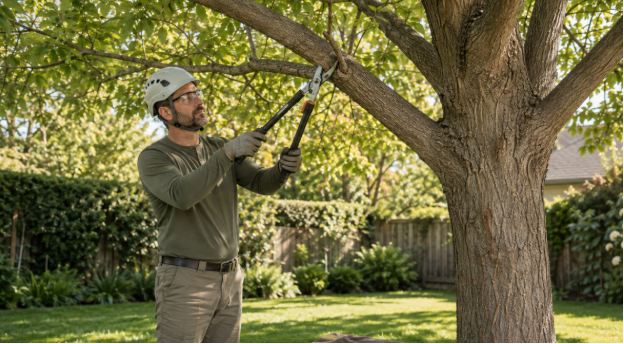

Tree pruning involves removing selected branches to improve a tree’s health, structure, safety, or appearance. It might look simple, but every cut changes how the tree grows.
Good pruning supports the tree’s natural shape. Poor pruning might leave large wounds, weak new growth, or an unbalanced canopy. Beginners should understand the purpose of each technique before reaching for a saw or pruning tool.
Why Do Trees Need Pruning?
Trees grow branches in many directions. Some become damaged, diseased, or crowded. Others rub together or grow toward buildings and walkways.
Pruning helps address these issues. It allows more light and air to move through the canopy, removes unsafe branches, and guides young trees toward a stronger structure.
Common reasons for pruning include:
- Removing dead or broken branches
- Improving branch spacing
- Clearing roofs, roads, or walkways
- Reducing weight on long limbs
- Correcting weak branch attachments
- Managing the size of a tree
- Improving fruit or flower production
Every pruning job should have a clear goal. Removing branches without a reason might create stress without providing a real benefit.
What Is Crown Cleaning?
Crown cleaning focuses on removing dead, diseased, broken, or weak branches. It is often the best place for beginners to start because the goal is clear.
Dead branches no longer support leaves and might fall without warning. Broken limbs also leave rough wounds that collect water and invite decay.
Cleaning does not mean removing every small branch inside the canopy. Healthy interior growth plays an important role in producing energy and protecting larger limbs from direct sunlight.
What Is Crown Thinning?
Crown thinning removes selected live branches to improve light and airflow. The work should be spread evenly throughout the canopy.
Too much thinning makes the outer ends of branches heavy while leaving the inside bare. This creates a shape sometimes called lion’s tailing. It increases movement at the ends of limbs and might make them more likely to break.
A properly thinned tree should still look full and balanced. The goal is not to see through the entire canopy.
What Is Crown Raising?
Crown raising removes lower branches to create space below the tree. This technique helps provide clearance for people, vehicles, buildings, and signs.
Lower branches should be removed gradually, especially on young trees. Removing too many at once might weaken trunk development and leave the bark exposed to strong sunlight.
A balanced canopy should retain enough growth along the trunk to support healthy development.
What Is Crown Reduction?
Crown reduction decreases the height or spread of a tree by shortening selected branches. Cuts should return long limbs to healthy side branches large enough to continue growing.
Reduction is different from topping. Topping cuts branches at random points and leaves large stubs. The tree often responds by producing many fast-growing shoots with weak attachments.
Proper reduction respects the natural structure of the tree. It is skilled work, especially on mature or large trees.
Where Should a Pruning Cut Be Made?
Most branches have a slightly swollen area where they connect to the trunk or a larger limb. This area is known as the branch collar.
The final cut should be made just outside the branch collar. Cutting too close to the trunk removes tissue needed for natural wound closure. Leaving a long stub also slows the process and might encourage decay.
Large branches require a three-cut method. The first cut goes underneath the branch. The second goes farther out from the trunk and removes most of the weight. The final cut removes the remaining stub outside the branch collar. This method helps prevent bark from tearing down the trunk.
Which Tools Should Beginners Use?
Hand pruners work well for small branches. Loppers provide more leverage for medium branches, while a pruning saw handles larger limbs.
Tools should remain sharp and clean. Dull blades crush plant tissue and leave rough cuts. Choose a tool designed for the branch size instead of forcing a small tool through thick wood.
When Should Professional Help Be Considered?
Avoid pruning branches near power lines, above buildings, or beyond safe reach from the ground. Large limbs are heavy and often move in unexpected ways as they fall.
Trees with major cracks, decay, storm damage, or significant lean also need careful evaluation. Beginners should focus on small, reachable branches and leave complex pruning to trained professionals.
Thoughtful pruning improves structure without removing more growth than necessary. Start with a clear goal, use the right technique, and allow the tree to keep its natural form.
This post was written by a professional arborist at Tree Service Company Largo FL. Robert Miller is the owner of Arbor Wise Professional Tree Care, a locally owned and operated tree service company that offers superb lawn care by the most experienced Arborists. Arborwise Tree Services is a tree removal company that offers stump removal, tree pruning, stump grinding, fertilization, and tree restoration. We have an extraordinary lawn care industry notoriety covering the Pinellas county area.